The AI video generation landscape is poised for a dramatic transformation by 2026. What once seemed like science fiction—AI systems that can generate cinematic footage with precise camera control, extended narrative sequences, and perfectly synchronized dialogue and sound—is rapidly becoming production reality. Leading platforms like LTX Studio are pioneering these advancements, fundamentally changing how filmmakers, marketers, and content creators approach video production. These AI video 2026 predictions highlight significant advancements that will reshape the industry.
The convergence of three major technological breakthroughs will define 2026's AI video landscape: directable cinematic AI with professional camera controls, extended shot capabilities that support storytelling, and synchronized audio-visual generation that eliminates traditional post-production bottlenecks. These innovations promise to compress production timelines by up to 68% while maintaining the creative control that professionals demand.
The Evolution of AI Video Technology
AI video generation has undergone a remarkable evolution. Early iterations produced short, often awkward clips with visible artifacts and inconsistent character behavior. The technology struggled with the uncanny valley effect in human interactions, lip-sync accuracy, and maintaining visual consistency across extended sequences.
Today's platforms have addr
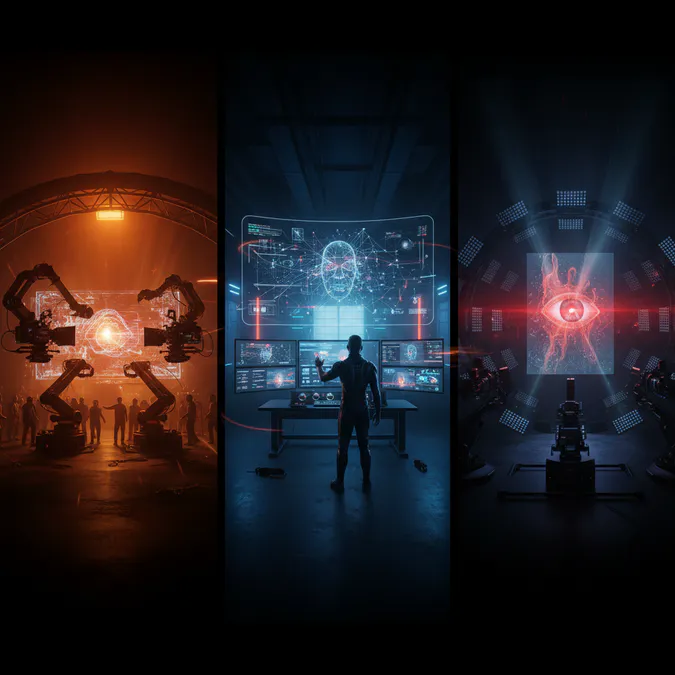
The progression from basic text-to-video to professional cinematic tools reflects a broader industry maturation. What distinguishes 2026 predictions from current capabilities is the emphasis on creative control, extended duration support, and integrated audio-visual workflows—features that bridge the gap between AI demonstrations and real-world filmmaking requirements.
Directable Cinematic AI: Professional Camera Controls
One of the most significant 2026 predictions involves directable cinematic AI video with sophisticated camera controls. This advancement moves AI video generation beyond simple scene generation into the realm of professional cinematography.
Professional camera movements that will become standard include:
- Dolly shots: Smooth forward and backward camera movements that create depth and draw viewers into scenes.
- Crane movements: Sweeping vertical and arc movements that establish scale and emotion.
- Handheld camera work: Dynamic, slightly unstable movements that convey urgency or realism.
- Pan and tilt operations: Horizontal and vertical camera rotations for following action or revealing information.
- Zoom and focus control: Precise depth-of-field adjustments that direct viewer attention.
These controls represent a fundamental shift in how creators interact with AI video systems. Rather than describing a scene and accepting whatever the AI generates, filmmakers can now direct specific camera movements, angles, and compositions. This level of control is essential for professional production workflows where visual storytelling requires intentional cinematographic choices.
According to Mohamed Oumoumad, CTO at Gear Productions, "For professional studios, this level of control is not optional. Training and steering video models like LTX is the most viable way to align AI with real production needs, where predictability, ownership, and creative intent matter as much as visual quality." [LTX.io] This perspective underscores why directable controls represent a watershed moment for AI video adoption in professional environments.
The LTXV-13B model powering these capabilities delivers 30x faster video generation compared to comparable models, enabling rapid iteration and real-time creative exploration. [Shaicreative.ai] This speed advantage means filmmakers can experiment with multiple camera movements and compositions without waiting hours for renders.
Extended Shots and Narrative Possibilities
Current AI video systems typically generate short clips—often 4-8 seconds—that struggle with narrative coherence and emotional pacing. The 2026 prediction for extended shots up to 20 seconds represents a critical breakthrough for storytelling.
Why Extended Shot Duration Matters
Narrative pacing: Longer shots allow scenes to breathe, establishing mood and building tension without jarring cuts. A 20-second uninterrupted shot can convey far more emotional information than multiple shorter clips.
Character consistency: Extended sequences enable AI systems to maintain character appearance, behavior, and continuity across longer timeframes, reducing the uncanny valley effect that occurs when characters shift subtly between shots.
Cinematic language: Professional cinematography relies on shot duration to communicate meaning. A slow, extended crane shot conveys different information than rapid cuts. Extended AI-generated shots enable this cinematic vocabulary.
Production efficiency: Longer shots reduce the number of individual generations required, streamlining workflows and reducing computational costs.
Emotional storytelling: Complex emotional narratives require time to develop. Extended shots allow characters to react, respond, and evolve within single sequences rather than across multiple disconnected clips.
The ability to generate 20-second sequences with consistent character behavior, lighting, and camera movement fundamentally changes what's possible with AI video. Marketing teams can create complete product demonstrations without cuts. Filmmakers can shoot entire scenes in single takes. Content creators can maintain narrative momentum without technical interruptions.
Synchronized Audio-Visual Generation
Perhaps the most transformative 2026 prediction involves unified audio-visual generation that synchronizes motion, dialogue, and sound from the initial generation stage rather than treating them as separate post-production elements.
Traditional vs. Integrated Workflows
Traditional video production workflows separate these elements:
- Video generation or filming
- Dialogue recording and editing
- Sound design and effects
- Audio mixing and synchronization
- Final composite and delivery
This sequential approach creates bottlenecks, requires specialized expertise at each stage, and makes revisions expensive and time-consuming. If a client requests dialogue changes, the entire audio-visual pipeline must restart.
Synchronized audio-visual generation eliminates these inefficiencies by generating motion, dialogue, and sound as integrated elements from the start. The AI system understands the relationship between character lip movements, dialogue timing, emotional tone, and ambient sound, generating all elements in perfect synchronization.
Advantages of Integrated Audio-Visual Generation
Eliminated lip-sync problems: No more mismatched dialogue and mouth movements. The system generates both simultaneously with perfect alignment.
Reduced post-production time: What previously required days of audio editing and synchronization happens during initial generation.
Coherent sound design: Ambient sound, dialogue, and effects are generated with understanding of the scene context, creating more natural audio landscapes.
Rapid iteration: Changes to dialogue or sound design don't require re-shooting or extensive re-editing. Regenerate with new parameters.
Lower production costs: Fewer specialized roles required, reduced equipment needs, and compressed timelines all contribute to significant cost savings.
LTX Studio's August 2024 releases introduced voice sync features and keyframe control that preview this integrated approach. The platform's evolution toward unified audio-visual generation represents the practical implementation of this 2026 prediction.
Production Efficiency and Timeline Compression
The convergence of directable cinematic controls, extended shots, and synchronized audio-visual generation produces a remarkable efficiency gain: up to 68% compression of production timelines using AI video and image tools. [LTX Studio Blog]
Timeline Comparison: Traditional vs. AI-Accelerated
Traditional workflow timeline:
- Pre-production planning: 2-3 weeks
- Scriptwriting and storyboarding: 1-2 weeks
- Location scouting and setup: 1-2 weeks
- Filming: 3-5 days
- Post-production editing: 2-3 weeks
- Audio work: 1-2 weeks
- Color correction and effects: 1-2 weeks
- Client revisions: 1-2 weeks
Total: 10-16 weeks
AI-accelerated workflow:
- Pre-production planning: 1 week (streamlined)
- Script and visual direction: 3-5 days
- AI generation with camera controls: 2-3 days
- Audio-visual refinement: 2-3 days
- Client revisions: 2-3 days
Total: 2-3 weeks
This represents approximately 68% timeline compression. More importantly, the compressed timeline doesn't sacrifice creative control or quality. Filmmakers maintain directorial authority over camera movements, shot composition, and audio elements while eliminating the tedious technical execution that previously consumed production time.
Zeev Farbman, CEO of Lightricks, articulates this advantage: "AI can automate some of the most time-consuming and tedious parts of production that otherwise interrupt the creative process, to free filmmakers to concentrate on the new and creative ideas they wish to actualize." [AiThority]
This efficiency gain has profound implications for content creators operating under budget constraints. The ability to produce professional-quality video in weeks rather than months means smaller teams can tackle projects previously requiring large crews and extended budgets.
LTX Studio's Leadership in AI Video Innovation
LTX Studio has positioned itself at the forefront of these 2026 predictions through continuous platform evolution and strategic technology partnerships.
Key Platform Capabilities
LTXV-13B Model: Delivers 30x faster video generation, enabling rapid iteration and real-time creative exploration. This speed advantage is crucial for professional workflows where time directly translates to cost.
LTX-2.3 Engine: The major 2026 update introduces sharper detail, stronger motion, cleaner audio, and native portrait support up to 1080×1920. Critically, LTX-2.3 runs fully locally via LTX Desktop, giving creators complete control over their content and processing without cloud dependencies.
Google Veo Integration: Access to Google's Veo 2 and Veo 3 models alongside LTXV-13B provides creators with multiple generation engines optimized for different creative scenarios.
Frame Creator and Keyframe Control: These features introduced in August 2024 enable precise control over individual frames and keyframe sequences, supporting the directable cinematic approach that defines 2026 predictions.
Voice Sync Features: Integrated dialogue and audio synchronization tools that preview the unified audio-visual generation predicted for 2026.
LTX Studio's ecosystem approach—combining multiple generation models, local processing capabilities, and integrated creative tools—addresses the complete production workflow rather than isolated generation tasks. This comprehensive approach aligns with professional production requirements where creators need end-to-end solutions rather than disconnected tools.
Zeev Farbman emphasizes this commitment: "We've worked closely with our design partners and creator community to ensure our platform meets their diverse needs better than anything else on the market. We remain committed to exploring new technology and enhancing LTX Studio's capabilities." [AiThority]
The Future of Professional Video Creation
The 2026 predictions for AI video technology represent more than incremental improvements. They signal a fundamental restructuring of professional video production workflows.
Implications for Different Creator Types
For filmmakers, these advancements mean:
- Pre-visualization of complete scenes before expensive production.
- Rapid iteration on creative ideas without reshooting.
- Extended creative control over cinematography without technical limitations.
- Reduced dependence on large crews and specialized equipment.
For marketing teams, the implications include:
- Ability to produce multiple video variations for A/B testing.
- Rapid response to market changes with new content.
- Significant budget reallocation from production to strategy.
- Democratization of professional-quality video creation.
For independent creators, these tools represent:
- Access to cinematic production capabilities previously requiring studio resources.
- Ability to maintain creative vision without technical compromises.
- Competitive parity with larger production operations.
- Sustainable business models based on content quality rather than production scale.
The convergence of directable cinematic controls, extended shot capabilities, and synchronized audio-visual generation creates a production paradigm where creative intent translates directly to finished content without technical intermediaries. This shift empowers creators at all scales while maintaining the professional quality standards that audiences expect.
As these technologies mature through 2026 and beyond, the question shifts from "Can AI generate video?" to "How do we integrate AI video generation into professional creative workflows?" The answer increasingly involves platforms like LTX Studio that bridge the gap between AI capabilities and real-world production requirements, where predictability, creative control, and visual quality converge.
Key Takeaways
- AI video 2026 predictions highlight significant advancements in cinematic control and production efficiency.
- Directable cinematic AI enables professional camera movements and enhances storytelling.
- Extended shot capabilities allow for deeper narrative engagement and emotional storytelling.
- Synchronized audio-visual generation streamlines production workflows and reduces costs.
- Platforms like LTX Studio are leading the charge in integrating these innovations into real-world applications.
Frequently Asked Questions
What are the main AI video 2026 predictions?
The main predictions include directable cinematic controls, extended shot capabilities, and synchronized audio-visual generation.
How will AI video technology change production timelines?
AI video technology is expected to compress production timelines by up to 68%, allowing for faster and more efficient workflows.
What role does LTX Studio play in AI video innovation?
LTX Studio is at the forefront of AI video innovation, providing tools that enable filmmakers and content creators to leverage advanced AI capabilities for professional video production.
Sources
- Automated Pipeline
- Everything You Need to Know About LTX Studio in 2025
- New LTX Studios Release Showcases Advancements in AI Video Capabilities
- LTX: The AI Video Multi-Solution Suite for Creation
- How AI Videos & Images Are Transforming Marketing
- Source: youtube.com
- Source: ltx.studio
- Source: ltx.studio